Step-by-step roadmap
How to start day trading without rushing into live risk
Not financial advice. This roadmap is educational. It does not recommend a market, strategy, broker, or position size. Trading can lose money quickly, especially with leverage.
- Simulator firstLearn the ticket and the routine without real capital.
- Size the riskConvert a risk budget and stop distance into shares.
- Compare the payoffCheck R:R before the trade, not after the outcome.
The short answer
If you are starting from zero, the useful order is: learn the vocabulary, pick a narrow market, write a one-page plan, practise it on paper, and review the decisions. Only after that should you decide whether live trading is appropriate for you. Many people decide it is not, and that is a valid outcome.
Starting does not require a paid signal group, a “pro” indicator pack, or a live account on day one. Those things can add cost and complexity before you have a process to test.
Before step one: a readiness check
- I understand that most people who day trade lose money.
- I can set aside regular time to study and review, not just watch screens.
- I am willing to practise on paper without pretending it is live.
- I know that leverage and frequent trading increase the consequences of mistakes.
- I will not use money I cannot afford to lose for speculative trading.
- I will verify tax and regulatory rules with a qualified professional.
How to start day trading: the roadmap, step by step
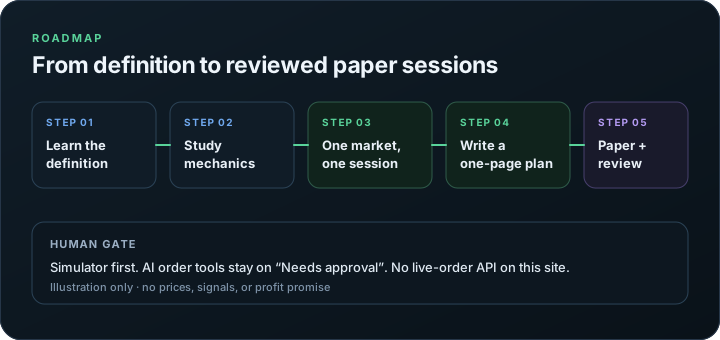
- Step 1 — Learn what a day trade is.
Read the plain-English definition and learn how it differs from swing trading and investing. Understand that a day trade is normally closed within the same session, and that the holding period changes the costs and the risks.
- Step 2 — Learn the mechanics.
Study market and limit orders, bid-ask spreads, liquidity, slippage, halts, and rejections. Learn how to read the order ticket and how to verify that a stop is actually working. If a term is unclear, stop and look it up before adding another indicator.
- Step 3 — Choose one market and one session.
Pick a single instrument and a defined time window. Write down the trading hours, the data source, and the conditions you will ignore. A narrow study is easier to review than a scattered tour of everything that moves.
- Step 4 — Write a one-page process.
Include the setup you are studying, the entry trigger, invalidation, position size, maximum loss, and a stop-trading rule. Add a rule for what you will do when the market is unclear: usually, no trade. Use the position size calculator to turn the risk budget into shares, and the risk-reward calculator to record the payoff you intend to test. The plan should be short enough to follow under pressure.
- Step 5 — Open a paper account.
Use a simulator or broker paper account that shows the order types and data you need. Confirm the data is live or delayed and understand how fills are modelled. Read what paper trading is before your first session.
- Step 6 — Run the same routine every session.
Check the account mode, the data timestamp, the spread, and the plan. Place only the orders your plan allows. Journal the reason, the fill, the outcome, and whether you followed the process. Repeated routine beats a dramatic first day.
- Step 7 — Review weekly.
Look for repeated mistakes: oversized positions, moving stops, trading outside the session, or entering without a defined invalidation. Change one thing at a time, then test the change on paper. Do not rewrite the whole plan after one loss.
- Step 8 — Treat live trading as a separate decision.
There is no certificate that makes live trading suitable. If you ever consider it, use only risk capital, keep position sizes small relative to the account, and understand that paper results can flatter a strategy. This site does not recommend that you make that switch.
A two-week starter plan
This is a study schedule, not a profit target. The aim is to make the workflow familiar and to produce a journal you can review.
| Days | Focus | Output |
|---|---|---|
| 1–3 | Definitions, order types, spreads, and risk vocabulary. | A one-page glossary in your own words. |
| 4–5 | Platform tour and simulated order entry. | A checklist for opening and closing a paper trade. |
| 6–8 | One market, one session, one written setup. | A one-page process with invalidation and size. |
| 9–12 | Paper sessions using the same routine. | Four journal entries with screenshots or notes. |
| 13–14 | Review and simplify. | A list of repeated mistakes and one change to test. |
What starting does not require
- A live account. You can learn mechanics and process on paper.
- An expensive course. Free documentation can teach the basics; verify the source and the date.
- A signal group. A call to buy or sell is not a process and does not transfer the reasoning.
- A complex indicator stack. Complexity can hide a weak plan.
- A guarantee. No tool, course, or mentor can promise a market outcome.
Common mistakes at the start
- Changing the plan after every loss instead of collecting enough decisions to review.
- Using a simulator with unrealistic fills and then assuming live results will match.
- Increasing size to make a small account “worth trading.”
- Adding leverage before understanding how it changes the loss profile.
- Confusing screen time with deliberate practice.
- Letting a chatbot or signal service make the decision without verifying the ticket.
Stop rule. If you cannot explain why you are in a trade, how you will exit, and what happens if you are wrong, you are not ready to place it. That rule applies on paper too.
The first milestone that matters
The first useful milestone is not a percentage return. It is being able to run the same process repeatedly and review it honestly. If you can do that on paper, you have learned something real. If you cannot, a live account will not supply the missing discipline.
For a broader foundation, read the beginner pillar. For the guardrails, read the safety checklist.
Compliance note. No stock picks, signals, profit promises, or trade-on-your-behalf service. Day trading is risky; most people who try it lose money.
Frequently asked questions
How do I start day trading with no experience?
Start with market mechanics, not stock tips. Learn order types, spreads, liquidity, and risk; choose one market and one session; write a one-page process; then rehearse it in a paper account and review the journal. Live trading is optional and should be a separate decision.
Do I need a lot of money to start day trading?
This site does not give personal financial advice or a required account size. You can start learning with a paper account and no trading capital. If you ever consider live trading, only money you can afford to lose entirely should be at risk, and leverage makes losses larger as well as gains.
What is the best market for a beginner?
There is no universal best market. Beginners often benefit from studying a liquid instrument with understandable trading hours and a simulator that matches the intended workflow. Avoid complexity such as thin markets, unusual instruments, or leverage before you can explain the basics.
How long should I paper trade before going live?
There is no fixed number of days or trades that certifies readiness. A more useful test is whether you can explain and follow your process, journal honestly, and review mistakes without changing the rules after every loss. Paper results still do not guarantee live results.
Do I need a mentor or a paid course?
Not necessarily. Free documentation, broker demos, exchange education pages, and books can teach the mechanics. Be cautious with anyone who promises returns, sells signals, or pressures you to trade live quickly. This site does not sell mentoring or signals.
Is day trading legal?
Rules vary by country and by broker. Some jurisdictions require specific licenses or registrations to advise others, and tax treatment depends on your situation. This is not legal or tax advice; verify the current rules where you live and speak to a qualified professional.